


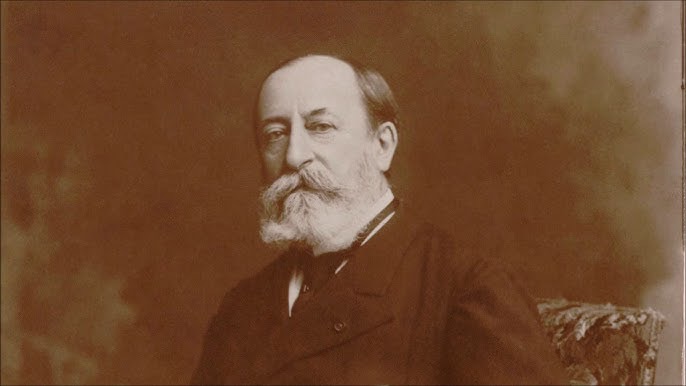
To search the press groups, associations for the blog” News-art-culture.com”. Camille Saint Saens enters in music with the talent and passion. He begins to study early the music , he is noted prodigious, intelligent, going along the artistic career through styles’ variety in compositions followed by success. In music to observe musical acuity, creativity, innovation of styles which are him the bases elements in compositions. He composes with passion! The talent enters in creativity! He loves the music with a big sensibility interpretative! How do we describe him? The pianist, composer, passionate of science…. Camille Saint Saens continues to surprise us.
Camille Saint Saens is birth to Paris the 9th October 1835 and die on 16th December 1921 has been a composer, organist and French pianist.
THE START IN MUSIC; PASSION, ARTISTIC WAY
He is born in riche family; father Victor is a governmental functionary which dies after three months from his birth leaving mother Françoise Clèmence single to occupied of him. The first pian lessons learning with aunt Charlotte demonstrating a big talent, motive which noted him a prodigious child, most doted from all times having an absolute ear, a big musical memory, that him help to learn the compositions from masters. At only two years he begins to compose. The first composition has been writing on 22 March 1839 being a short fragment for pian, today find it in archive at National Library from France.
Intelligent, precocious, talented….
Camille Saint Saens is an early talent in this way at three years old he knows yet to read, to write, at four years he learns the Latin language and begin to make present the compositions in public of where he has a big admiration, continuing at only five years to interpreting a sonata at pian by Beethoven. Without to leave the time’s passing he is animated by o big artistic sensibility for the study of Don Giovanni’s musical piece.
For him, nothing is extraordinary!
He is the little composer! In the year 1842 at 7 years, he is takes of artistic soul, yet we can say that he is seduced by Goddess of music and sustain the first concert at Room Ignaz Pleyel paying Concert no. 15 for pian by Mozart in Si major and pieces by Handel, Hummel and Bach. Added at concert he plays at memory thirty-two of sonatas for pian by Beethoven (information, incredible performance for Europe and United States published in paper Boston). He enters at Conservatory of Paris for studying organ and for composition becoming the student of Jacques Halévy. Over the years he win many prizes, but he cannot obtain the prestigious “Roma Prize “. Through others concerts he knows Franz Liszt, being the one of the best friends that look him with admiration for his compositions. At the 16 years old he writes the first symphony, published Symphony no.1 in mi major that is followed with curiosity and admiration from critic part and composers. Hector Berlioz , a good friend, after listen to him, leaves the commentary: He knows all, but to miss him the inexperience “. At 25 years old he makes a travel in Europe for demonstrated his musical genie continuing with the passion for the vegetal and animal science study, study of geology, archeology, mathematic, botanic and entomology where he is more careful to experimenting lepidopteries.
Composer, intellectual, researcher…..?
THE MUSICAL ACTIVITY FROM CAMILLE SAINT SAENS
In wide creative activity he works as organist in varies churches from Paris a way that help him to surviving in social and cultural world. In the years 1857-1877 he replaces Lefébure Wèly in role of organist at church Magdalena. His artistic representations to highlighting through improvisations that delight the Parisian public, he makes Liszt after listening his music to affirm: “ Camille Saint Saens is better organist of world”. In the years 1861- 1865 he teaches at lessons at pian and Niedermeyer school where he abandons the musical tradition of big masters ( Bach, Mozart and Beethoven) entering with the new style in works programs and contemporary musicians (Liszt, Gounod, Schumann, Berlioz and Wagner). Among his students from compositions entered in celebrity there are André Messager and Gabriel Fauré(Fauré being his preferred student which later becomes him friend). He amplifies the composer activity, of executor, and musical publicist writing varies articles in material of acoustic, among varies disciplines and congresses with better researchers from Europe, that determine him to follow the occult science and philosophic sciences. For to know him, we enter more need in creative life: he writes philosophic work “ Problèmes et Mystères” where are sciences thinks and art linked of religion. He anticipates existentialism with pessimist vision writing the poesy volume “ Rimes familières” and comedy”Le crampe des écrivains” (with success) . He becomes member of Society Astronomic from France. He takes the conference on the theme of mirage presenting a telescope build on his precise indications. He projects the concerts, correspondences and astronomic events (solar eclipse). He enters in National Garde for to fight in Franco-Prussian war where enter disillusions and politic changes. He subscribes at National Society of Music for promoting the new and original style of music for modulate the future French music. He has been friendly but in varies moments is known as enemy, presenting as irritable person for musicians’ majority despising much of his colleagues of this country as Franck d’Indy, Massenet, Claude Debussy. In France has been the one from the first supporters of Wagner music, proposing the pieces from his works in time of Niedermeyer school in special in March of Tannhauser in French language. After the first representation of Wagner to pian he continues to delightful with a entire orchestral piece appertaining at Lohengrin, Tristan and Isolda, Siegfried; as a reward Wagner define him “most musical mind from epoch”. In same time there are hard commentaries linked of antisemitism entered with Parisian scenography represented in Lohengrin where come back for to protect his musical personality with public declaration do not be a lover of Wagner’s works. After the first Mondial war to intensifying the hostility from French part and Allemands through series of articles provocateurs Allemands attacking with hardness Wagner’s music.
CAMILLE SAINT SAENS’ MUSIC
For the one first he introduces the symphonic poem. He enters in music most modern, making entering Liszt and Wagner into representative epoch and dominated by Bach and Mozart’s music. In a way less commune he represents the artistic modernity personification transforming later in reactionary musician. In XX century becomes ultra conservatory fighting fierce against Debussy and Richard Strauss influence. His imagine is situated at limit that separate the famous, notorious composers. His works are well definite, clean professional concept without to be excessive. The pianistic compositions constituting the stylistic link between Liszt and Ravel. Having o big ability in thematic elaboration is named “The first Allemand from all French composers”. His compositions are tight linked by classic tradition; someone is considered a neoclassicism precursor. He is looked as executor and considered an organist “without equals” at pian nearby Liszt becomes the one of the most pianists of Europe. The style is modulated, raffinate, playing with scales and sweet passages having aristocratic refinement. His imperfection is to be cold and methodic excessive. Through another considerations, he is the first pianist followed in public for the concerts cycle sustaining at pian. He remains a prolific composer in works having thirty musical compositions being in same time the one from the first writers of cinema * the film by Henri Lavedan (Duc de Guise’s murder).
The artistic merits: Knight of Big Cross of Honor Legion.
In last years of artistic consecration, we remember the year 1886 in that he compose most known works “ Le Carnaval des Animaux , Symphony no.3” dedicated in memory of Franz Liszt. After the death of his mother, he goes out France refuging in Canari island adopting pseudonym of Sannois. In passing years he travels around world developing the exotic places in Europe, North Africa , South-Est Asia , South America writing another musical, scientific arguments and historic of Alger(capital of Algerie) . He dies of pulmonary infection the 16 December 1921 at Oasis Hotel of Alger , comeback at Paris for to be buried in Montparnasse Cemetery.
THE COMPOSITIONS
Piano: Sei Bagatelle, Mazurka, Sei Studi, Menuet, Valse, Allegro Appassionato, Valse Ampio, Sei Fughe, Foglie de album, Romanza senza parole, Polonese, Scherzo, Capriccio arabe, Capriccio eroico, Duettino, Fantasie, Teme varie, Ricordi di Italia, Vals gioioso…
Organ Fantasie No.1, No.2, No.3, Benedizione nuziale, Tre Preludi, Fughe op.99, op.109, Marche religiose, Preghiere, La Predicazione degli uccelli…
Violin and pian: Danza macabre, Sonata per violino, No.1, Op.75, Elegie No.1, No.2 Op.143, Op.160, Suite, Op.16, Sonata per violoncello, Romanza in re maggiore, Sonata per violoncello no.2 Op.123…
Poem symphonic: Phaeton, Danza macabra, La giovinezza di Hercule ….
Music sacre: Messa, Tantum Ergo Op.5, Messa di Requiem, Ave Maria, Tu es Petrus…
Opera: Il francobollo di argento, Principessa giovane, Samson e Dalila, Enrico VIII, Ascanio, Déjanire, Barbari, Phryné, Proserpina…
With talent he follows the artistic world for express his music defying the epoch’s traditionalism with modern music modeling French style. He listens, plays Bach, are the passion for Mozart, valorizing Schumann ‘s music, but remains near of Liszt, Wagner and Ravel having a connection of style with modern music. He is innovator in compositional thematic, raffinate in aristocratic style in expressing the symphonic poems, composing the works in sweet passages. From compositions he passes at concerts for pian playing full pieces at memory with delighting improvisations defying traditionalism. His talent and passion are revealed for defining the expression in music.


Recent Comments